
Educational information: This article is not a property assessment, engineering or environmental opinion, dispatch promise, insurance determination, or authorization for work.
When water reaches a wall, floor, ceiling, or cabinet, removing the visible puddle is only the beginning. Porous and semi-porous materials can absorb and move moisture beyond the area that looks wet. Structural drying is the organized process of identifying affected materials, removing accessible water, creating appropriate drying conditions, monitoring progress, and verifying the result with measurements.
The goal is not simply to make a room feel dry. It is to reduce excess moisture in materials that can be safely retained, while documenting how conditions change. Every building and water event is different, so the drying plan should be based on the source, affected materials, accessibility, environmental conditions, and observations made at the property.
Structural drying is part of water mitigation
Water mitigation focuses on limiting additional damage after an indoor water intrusion. Structural drying is one part of that work. It generally begins after the immediate source has been stopped or controlled and accessible standing water has been removed. Learn more about our water mitigation services.
The U.S. Environmental Protection Agency explains that moisture can enter and move through buildings as liquid water, capillary movement, air-transported vapor, and vapor diffusion. A dry-looking surface does not necessarily describe the entire assembly. Water from a supply line, appliance, or other indoor source may travel under flooring, into base materials, or through connected cavities.
Drying begins with the right questions
- Where did the water originate, and is the source controlled?
- Which rooms, assemblies, and materials may be affected?
- Are there electrical, structural, contamination, or access concerns that require a qualified specialist?
- Which materials can reasonably remain in place, and which require a separate evaluation?
- Where can measurements be repeated consistently?
These questions shape the work. They also prevent an equipment-only approach in which machines are placed without a documented understanding of what needs to dry.
The five stages of a structural drying process
1. Initial assessment and moisture mapping
The affected area is inspected, and moisture observations are organized into a map. A technician may compare suspected wet locations with similar materials in an unaffected area. Depending on the material and the instrument, readings may be qualitative, relative, or expressed as moisture content.
The purpose of the map is to establish a repeatable baseline. Locations should be specific enough to revisit: for example, a named room, wall, material, and measurement point. Photos and notes can add context, but they do not replace readings.
2. Removal of accessible water
Physically removing water is different from evaporating it. When water can be extracted or otherwise removed safely, doing so reduces the amount that must later leave materials through evaporation. The exact method depends on the surface, assembly, source conditions, and access.
Water may also remain in concealed or layered areas. That is why extraction is followed by assessment rather than treated as proof that the structure is dry.
3. A site-specific drying setup
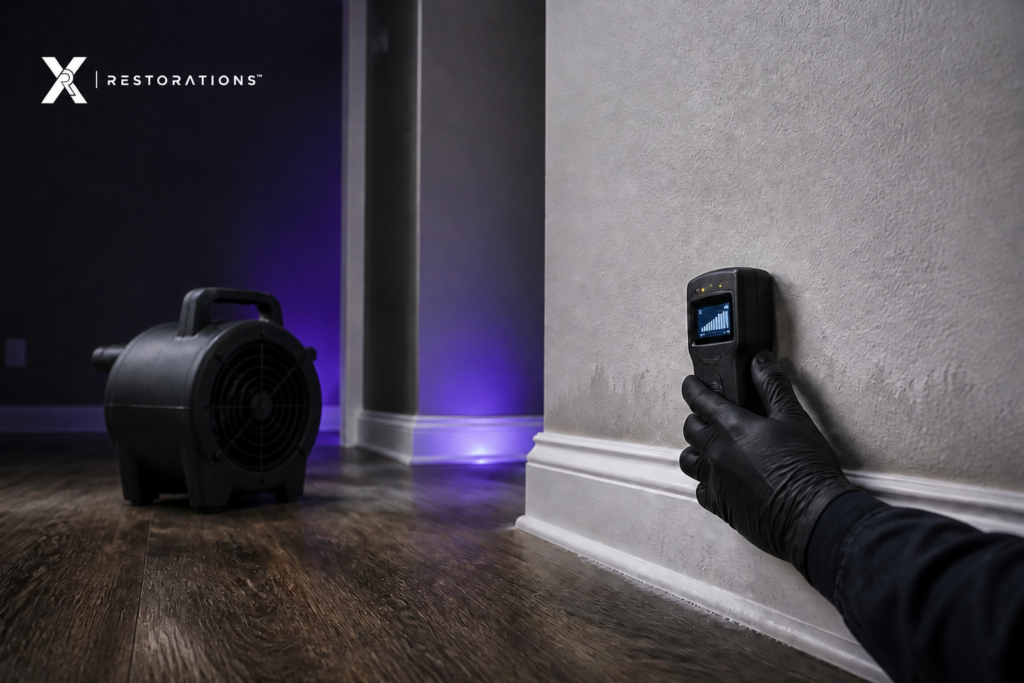
Drying equipment is selected and positioned to support evaporation and moisture removal. Air movement can help moisture leave wet surfaces, while dehumidification can remove water vapor from the air. The arrangement may change as the job progresses.
More equipment is not automatically better. Airflow paths, room boundaries, material exposure, temperature, humidity, and equipment capacity all influence the setup. Unsafe utilities, suspected contamination, or other complications can also change what is appropriate. The plan should respond to observed conditions rather than rely on a fixed recipe.
4. Ongoing moisture monitoring
Drying is a process, not a one-time reading. Repeat measurements show whether materials are moving toward the selected drying goal. Environmental readings, equipment status, and changes to the setup provide additional context.
A useful drying record identifies when and where a reading was taken, the material tested, the instrument or mode used, and the result. Consistency matters: comparing different materials, locations, or instrument settings can create a misleading trend.
If readings plateau or unexpected moisture appears, the information can prompt a reassessment. The team may need to inspect access, airflow, equipment operation, an overlooked moisture source, or the behavior of a particular assembly.
5. Verification before the drying setup ends
A room that feels comfortable or a wall that looks normal may still contain excess moisture. FEMA guidance on cleaning flooded buildings notes that touch and sight alone are not reliable ways to determine moisture content and calls for materials to be rechecked after drying. Although indoor intrusions are not all flood events, the measurement principle is useful: completion should be supported by evidence.
There is no single universal number that makes every material in every building “dry.” A drying goal may consider comparable unaffected materials, manufacturer requirements, material type, local conditions, and the purpose of the surface or assembly. A responsible closeout states what was measured and why the documented conditions supported ending the drying phase.
Why some materials dry differently than others
Building materials do not absorb, hold, or release water in the same way. Dense wood, engineered wood, gypsum-based products, concrete, masonry, insulation, and finish layers behave differently. Coatings and floor coverings may also slow evaporation from the material beneath them.
Assemblies matter as much as individual products. A wall may contain paint, wallboard, framing, insulation, and an adjacent finish. A floor can include a surface covering, adhesive, underlayment, and subfloor. Moisture may leave one layer while remaining in another, or it may move toward a cooler or more vapor-open area.
The EPA’s moisture-control guidance emphasizes controlling liquid water, managing condensation and vapor movement, and allowing wet materials to dry before they are enclosed or covered. In a mitigation setting, that supports a practical rule: avoid assuming that one surface reading describes everything behind or beneath it.
What a property owner can expect to see documented
- the reported water source and whether it was controlled;
- rooms, materials, and accessible areas evaluated;
- initial and follow-up moisture readings at identifiable locations;
- indoor environmental readings relevant to the drying setup;
- equipment placed, moved, adjusted, or removed;
- observed complications or areas that could not be evaluated;
- photos tied to dates and locations; and
- the basis used to conclude monitored drying.
Documentation does not make every hidden condition knowable, and it does not replace specialized evaluation when one is needed. It does make the decisions and progress easier to understand.
Structural drying should be evidence-led
The most useful way to think about structural drying is as a measured sequence: understand the water pathway, remove accessible water, support drying, monitor the affected materials, adjust when the data calls for it, and verify the result. The equipment is important, but the measurements connect the equipment to the building.
If an indoor water intrusion has affected building materials, X Restorations can evaluate accessible areas for water mitigation, establish a drying approach when appropriate, and document moisture-monitoring progress. Conditions vary, so the next step begins with information about the source, affected area, and current site conditions. Request an assessment or call (813) 351-9419.