
September 11, 2026
How Moisture Mapping Helps Define the Affected Area After Water Intrusion
The visible wet area may not show the full path moisture has taken through a building assembly. A moisture map organizes observations and readings so the drying plan can follow evidence instead of appearances.
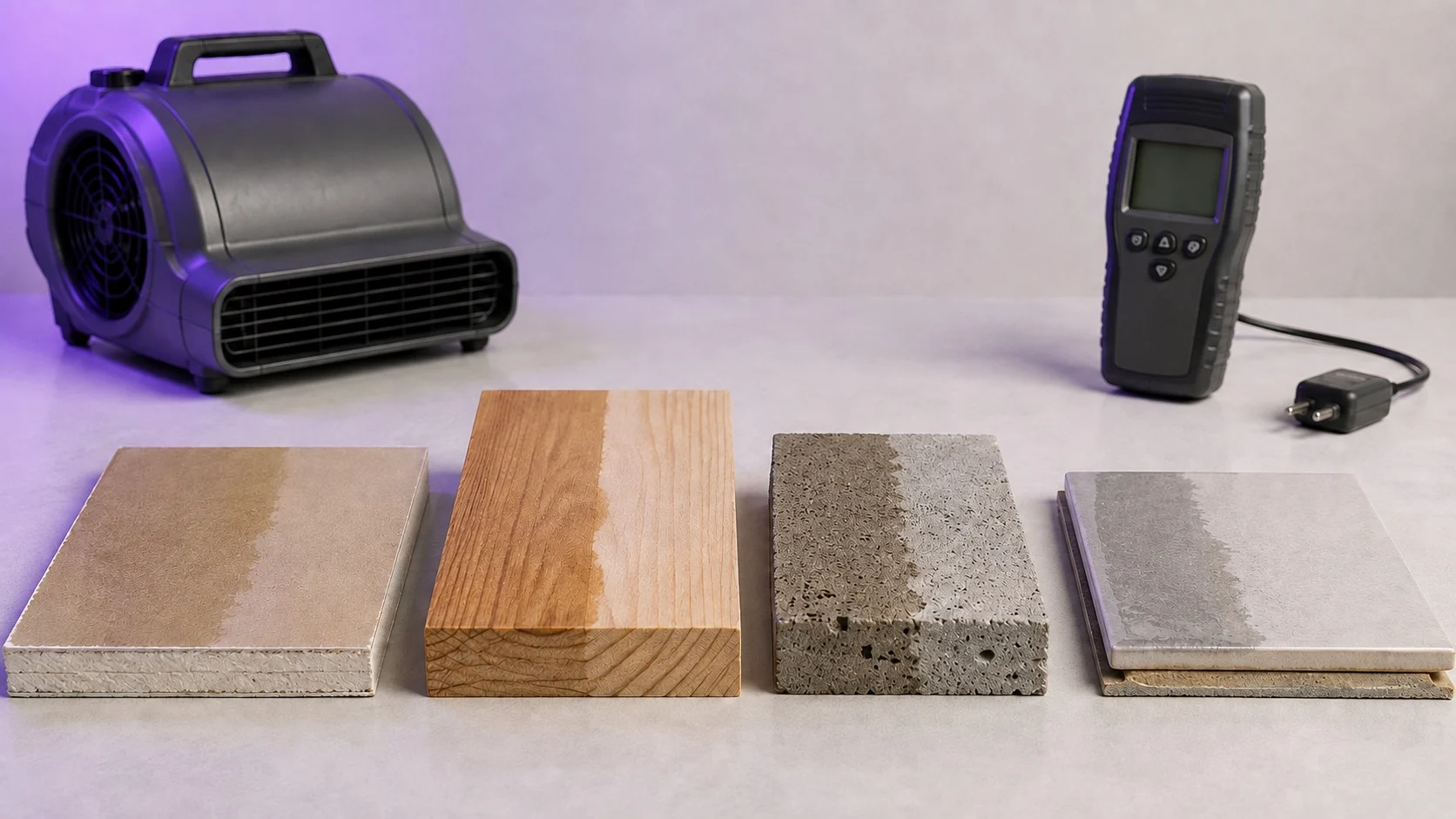
A wet spot is easy to notice. The full affected area can be harder to define.
Water can move through seams, porous materials, floor-to-wall transitions, and concealed parts of a building assembly. That means the visible edge of a stain or puddle is useful evidence, but it is not automatically the final boundary. A moisture map brings observations and material readings together so the next drying decision can be based on a documented pattern.
This article explains what a moisture map can show, why readings must be interpreted by material and location, and where the limits of the tool matter.
The visible wet area is a starting clue, not a complete boundary
The U.S. Environmental Protection Agency explains that moisture can move into and within buildings in several ways, including liquid flow, air movement, vapor movement, and capillary action through porous materials. Its Moisture Control Guidance for Building Design, Construction and Maintenance also emphasizes that understanding how water moves is central to controlling it.
After an indoor water intrusion, surface appearance may change before all affected layers behave the same way. Paint, paper-faced gypsum board, wood, concrete, flooring, adhesives, and underlayments each interact with moisture differently. A moisture map helps organize those differences instead of treating an entire room as one uniform surface.
What a moisture map records
A moisture map is not just a collection of numbers. It is a repeatable record that connects each observation to a specific place and material. A practical record may include:
- Location: the room, wall, floor section, ceiling area, or transition being checked.
- Material or assembly: for example, gypsum board, wood framing, concrete, a floor finish, or a layered floor system.
- Reading method: the instrument, mode, and test approach used at that point.
- Date and conditions: when the observation was made and relevant indoor conditions at that time.
- Visible context: staining, swelling, separation, odor, or another observation that helps explain the reading.
- Reference information: a comparison point or other context appropriate to the material and instrument.
The purpose is consistency. If a point is checked again, the new observation can be compared with the same location, material, and method instead of with a different surface somewhere else.
Why different materials need separate observations
A meter response on wood is not automatically equivalent to a response on gypsum board, masonry, tile, or a layered flooring system. Materials differ in density, porosity, thickness, coatings, and how they are assembled. Those differences can affect both moisture movement and instrument response.
Research published by the National Institute of Standards and Technology notes that some electrical resistance instruments are useful for identifying wet areas and moisture-migration patterns, while also warning that simple instruments may provide qualitative rather than precise moisture-content information. The same paper discusses calibration and material-related limitations. That is an important caution: a reading should be interpreted in context, not treated as a universal score for every surface. See the NIST review of nondestructive evaluation methods.
For the same reason, a map should identify the material at every point. It should not flatten unlike materials into one color or one threshold without an appropriate basis.
How repeat readings guide mitigation and drying adjustments
One reading is a snapshot. Repeat observations at documented points can show whether the apparent boundary is stable, whether another area deserves investigation, and whether the pattern is changing over time.
That trend can help organize practical questions:
- Are readings changing at the same documented locations?
- Does one material respond differently from the material beside it?
- Does the visible boundary agree with the measurement pattern?
- Is there a floor-to-wall or cabinet transition that needs separate attention?
- Do the current observations support continuing, changing, or reassessing the drying setup?
The map does not promise a drying time. It creates a traceable record for comparing conditions. For a broader explanation of the process, read Structural Drying After Indoor Water Intrusion and Why Moisture Monitoring Matters During Water Mitigation.
What a moisture map cannot determine by itself
A moisture map is useful, but it is not a complete diagnosis. By itself, it does not establish:
- the source or cause of the water intrusion;
- the cleanliness or contamination category of the water;
- structural safety or electrical safety;
- the condition of every concealed layer;
- whether microbial growth is present;
- whether a material must be removed or can remain; or
- insurance coverage or the scope of a claim.
Those questions require additional facts, site-specific judgment, and sometimes other qualified professionals. A meter reading should not replace a safety evaluation or be used to make a demolition decision from a distance.
What useful drying documentation should make clear
Good documentation should let another reader understand what was observed, where it was observed, how it was checked, and how the pattern changed. A simple sketch or floor plan, labeled reading points, dated notes, material descriptions, photographs, instrument information, and recorded indoor conditions can make the sequence easier to follow.
The public overview of the ANSI/IICRC S500 Standard for Professional Water Damage Restoration identifies building and material science, psychrometry and drying technology, equipment and instruments, project documentation, inspections, and materials and assemblies among the subjects addressed by the professional standard. The standard itself governs professional practice; a homeowner-created sketch is not a substitute for that work.
When to discuss moisture monitoring with a restoration professional
Professional input can be useful when water has affected more than one material, the visible boundary is unclear, readings conflict with what the surface appears to show, or the assembly includes concealed or layered components. If there may be structural, electrical, or contamination hazards, avoid unsafe entry or handling and contact the appropriate qualified professional.
X Restorations focuses on water mitigation, structural drying, and moisture monitoring. If indoor water has affected more than one material—or the boundary is unclear—contact X Restorations to describe what you are seeing and confirm service availability. The appropriate next step depends on site conditions and documented observations.