
Resources
Why Moisture Monitoring Matters During Water Mitigation
See how repeated moisture readings guide water mitigation, reveal drying trends, support equipment decisions, and document completion.
Educational information: This article is not a property assessment, engineering or environmental opinion, dispatch promise, insurance determination, or authorization for work.
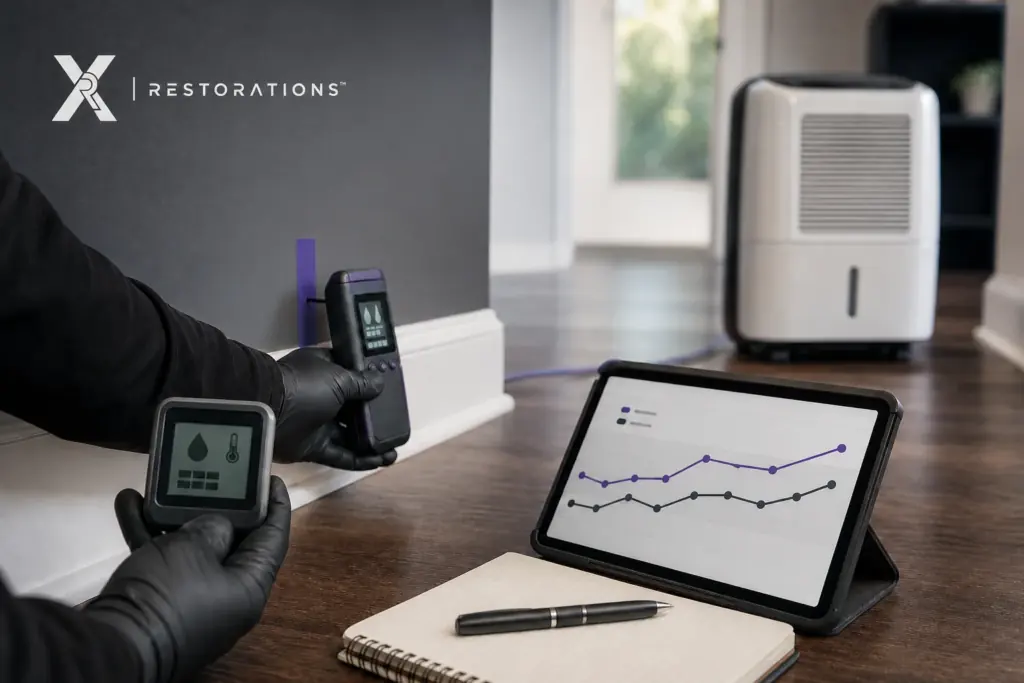
Water mitigation changes over time. Materials release moisture, indoor air conditions shift, equipment runs, and water can move into areas that were not obvious during the first look. A single inspection captures only one moment. Moisture monitoring turns those moments into a documented trend that can guide the drying process.
Related guidance: Learn what structural drying means after indoor water intrusion, review our water damage restoration information, or contact X Restorations about current site conditions.
Monitoring does not mean chasing one universal “dry” number. It means taking repeatable readings at identified locations, interpreting them in context, and using the results to decide what should be checked or adjusted next. Done carefully, it helps connect the work taking place in a room with the condition of the materials being dried.
Visible dryness is not the same as measured progress
Water can travel below a finish, along a seam, or into a connected cavity. Paint may look normal while the material behind it remains elevated. A floor surface can feel dry while moisture persists in a layer below. Air can feel comfortable even though a dense material is still releasing moisture slowly.
The U.S. Environmental Protection Agency describes several ways moisture moves through buildings, including liquid flow, capillary action, air movement, and vapor diffusion. FEMA’s guidance on drying flooded buildings also explains that moisture content is difficult to judge accurately by sight or touch alone. These sources address broad building and flood-recovery conditions, but the core lesson applies to indoor mitigation: appearance is useful evidence, not complete evidence.
Measurements add another view. They help identify the initial extent that is accessible, show whether conditions are changing, and support a more reasoned endpoint.
A baseline makes later readings meaningful
Monitoring begins with a baseline. The first set of readings records the conditions found before or near the beginning of the drying setup. Locations need clear identifiers so the same areas can be revisited.
For example, “bedroom wall” is vague. “Bedroom, north wall, painted gypsum board, twelve inches above the base, near the door” is repeatable. If the instrument, material, mode, and approximate location remain consistent, later readings can show a trend rather than an accidental comparison.
A baseline may include:
- affected and suspected materials in accessible areas;
- similar materials in an apparently unaffected comparison area;
- room temperature and relative humidity when relevant;
- instrument identification or measurement mode;
- date, time, and exact reading location; and
- conditions that limit access or interpretation.
Comparison areas are helpful because normal conditions vary among buildings, materials, and locations. They are not a substitute for manufacturer requirements or professional judgment, but they provide site-specific context.
Monitoring helps answer practical questions
Repeated readings support decisions throughout mitigation.
Is the material moving in the expected direction?
A series of readings can show a downward trend, a plateau, or an unexpected increase. The trend is often more informative than an isolated value. If a material is not changing as expected, the team can investigate before assuming the setup is working.
Is the drying arrangement reaching the affected area?
Air movement and dehumidification affect the air, but the materials are the object of the drying work. Readings can reveal whether a concealed, dense, layered, or poorly exposed area needs closer review. They may lead to changes in access, equipment position, room boundaries, or the monitoring plan.
Could there be another moisture source?
An unexpected increase does not prove the cause, but it creates a reason to look. A source may not be fully controlled, condensation may be influencing a cool surface, or moisture may be migrating from an adjoining area. Monitoring helps flag the question; investigation determines the explanation.
When is there evidence to end monitored drying?
Equipment should not remain simply because it was placed, and it should not be removed solely because a room feels better. Measurements compared with the selected drying goal help support the decision. The closeout record should explain the goal, the readings used, and any areas that could not be assessed.
Different instruments answer different questions
“Moisture reading” is a broad phrase. Instruments and modes do not all produce the same kind of information.
Non-penetrating meters can help scan accessible surfaces and compare response patterns without inserting pins. Pin-type meters take readings through contact points and may help evaluate material at a selected depth, depending on the instrument and probe. Thermo-hygrometers measure air conditions such as temperature and relative humidity. Some equipment also calculates or displays other psychrometric values.
These readings should not be mixed as though they are interchangeable. Instrument limitations, material composition, coatings, density, embedded metal, temperature, depth, and selected scale can affect the result. A number displayed by one mode may be relative rather than a literal percentage of water by weight.
This is why a useful log identifies the instrument, mode, material, and location—not just the number. It is also why readings should be interpreted within the instrument manufacturer’s instructions and the conditions at the site.
What a drying log should communicate
A drying log is more useful when another person can understand what changed without guessing. It can include:
- project identifier and monitored area;
- date and time of each visit or observation;
- material and measurement point;
- reading and instrument or mode;
- relevant indoor environmental conditions;
- equipment operating in the area;
- equipment or boundary changes made that day;
- observations, exceptions, and inaccessible locations; and
- the drying goal or comparison used for completion.
Photos can support the record when tied to specific dates and places. A photo of a meter display without a labeled location or material, however, has limited value. Good documentation preserves context.
The log should also distinguish facts from interpretations. “Reading decreased from X to Y at the labeled point” is an observation. “The decrease occurred because of a specific adjustment” may be a reasonable hypothesis, but it should not be presented as proven unless the evidence supports it.
Common monitoring mistakes
Several shortcuts can weaken the value of moisture data:
- taking a reading once and treating it as the complete drying record;
- comparing different materials as if they share the same scale;
- changing locations or instrument modes without noting the change;
- recording numbers without dates, room names, or material types;
- relying only on room humidity to describe moisture inside materials;
- using only visual appearance or touch to declare completion;
- treating an instrument response as proof of what caused the moisture; or
- ignoring areas that could not be accessed or reliably measured.
Monitoring is strongest when it is repeatable, transparent, and limited to what the data can actually show.
What property owners can ask about the monitoring process
Clear questions make a technical record easier to understand:
- Which materials and locations are being tracked?
- Were similar unaffected materials used for comparison?
- How often are the same points being rechecked?
- What changes would cause the drying setup to be adjusted?
- What drying goal is being used, and why is it appropriate here?
- Are any areas inaccessible or outside the scope of the readings?
- What documentation will be available when monitored drying ends?
The answers may vary because the building and event determine the plan. The important point is that the plan and its limitations can be explained.
Monitoring connects action with evidence
Moisture monitoring is not a decorative step added to water mitigation. It is the feedback loop. Initial readings establish what is known, follow-up readings show direction, and documented comparisons support adjustments and closeout. When readings are consistent and interpreted carefully, they help keep the drying process focused on the building materials rather than on assumptions.
If an indoor water event has affected accessible materials, X Restorations can evaluate the mitigation area, establish repeatable monitoring points, and document drying progress when appropriate. The approach depends on the source, materials, access, and actual site conditions.
Sources and further reading
- U.S. EPA — Moisture Control Guidance for Building Design, Construction and Maintenance (page updated April 13, 2026)
- U.S. EPA — Questions and Answers on moisture meters after water damage
- FEMA — Cleaning Flooded Buildings
- U.S. EPA — Mold Course, Chapter 2: moisture and drying buildings
- U.S. Department of Energy — Building Enclosure: Introduction to Moisture Flow