
Resources
Temporary Removable Tarp Protection After a Storm: What It Can—and Cannot—Do
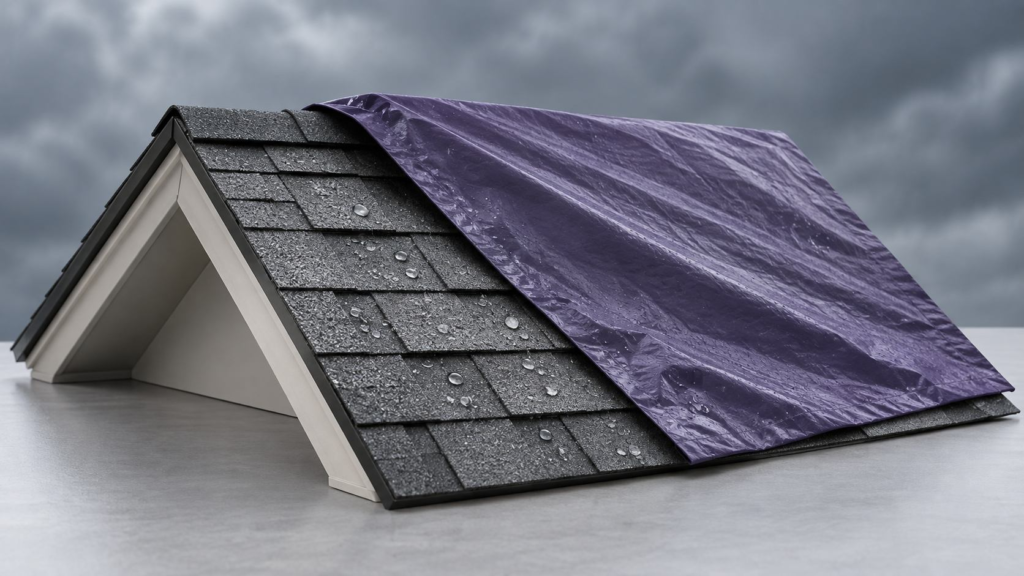
A temporary removable tarp may help reduce additional rain exposure after a storm, but it does not replace roof repair, structural evaluation, interior mitigation, or safe access planning.
Educational information: This article is not a property assessment, engineering or environmental opinion, dispatch promise, insurance determination, or authorization for work.
After a storm affects a roof, stopping or reducing additional rain entry can be an urgent priority. A temporary removable tarp may serve as a short-term protective measure while permanent repairs are being evaluated and coordinated. It is a bridge between the immediate weather exposure and the work that still needs to follow—not a replacement roof and not proof that the building is dry.
The U.S. Army Corps of Engineers describes temporary roof covering as a way to help protect damaged roofs until permanent repairs can be arranged. OSHA separately identifies roof inspection, tarping, and repair as work with serious fall and other hazards. Those two ideas belong together: temporary protection can be useful, but only when the limits of the covering and the safety demands of the work are understood.
What temporary removable tarp protection is meant to do
A temporary covering is intended to reduce direct weather exposure over an affected portion of a roof for a limited period. When conditions and safe access allow, it may help limit additional rain entry while the property owner coordinates a permanent roofing decision. Its purpose is provisional: protect the exposed area as reasonably as conditions allow and create time for the next qualified evaluation.
The exact approach depends on the roof surface, the location and extent of visible damage, wind and weather conditions, safe access, and the limits of the selected material. A tarp should not be presented as universally appropriate for every roof or every storm condition. X Restorations’ scope, when appropriate and available, is limited to temporary removable non-mechanical tarp protection; it does not include a permanent roof repair.
What a temporary tarp cannot establish
A tarp cannot confirm that the roof structure is stable, that every opening has been identified, or that water will not enter somewhere else. It does not determine whether roofing components should be repaired or replaced, and it does not guarantee watertight performance through future wind or rain. It also does not remove water that has already entered wall, ceiling, insulation, flooring, or other building assemblies.
Exterior protection and interior water mitigation are related but separate decisions. A covering may reduce one source of new exposure, while accessible water, affected materials, and moisture conditions inside still require their own evaluation. Our overview of storm damage restoration explains why temporary protection, documentation, mitigation, and permanent repair should not be treated as one interchangeable step.
Roof safety comes before the covering
Storm-damaged roofs may involve wet surfaces, loose materials, concealed weakness, debris, electrical concerns, and changing weather. OSHA’s hurricane recovery guidance treats roof inspection, tarping, and repair as hazardous work and identifies fall protection, controlled access, training, and appropriate equipment among the safeguards for workers. NIOSH likewise emphasizes planning, proper equipment, and training to prevent falls from roofs and ladders.
Property owners and occupants should not climb onto a roof to inspect damage, adjust a tarp, or take photographs for documentation. Observe only from a safe location. If there are signs of collapse, downed or damaged electrical components, active movement, or another immediate danger, stay away from the affected area and contact the appropriate emergency or qualified service provider.
Why the affected area still needs a site-specific review
Water does not always enter directly below the most obvious exterior damage. It may follow roof decking, framing, penetrations, insulation, or interior finishes before becoming visible. A temporary exterior covering therefore should not be used to infer the full interior affected area. Safe observations from below, visible water paths, material condition, and moisture measurements can provide different pieces of the picture.
This is also why a temporary covering should not silently expand into a promise about drying. The article How Moisture Mapping Helps Define the Affected Area After Water Intrusion explains how documented locations and material-specific readings can support a clearer interior assessment without assuming that visible staining marks the entire boundary.
What can be documented safely
Useful documentation does not require roof access. From a safe location, record the date and time, the weather conditions, rooms where dripping or staining is visible, changes since the last observation, and actions already taken. Photographs from the ground or from safe interior areas can help establish a timeline. Note whether water entry appears active, intermittent, or no longer visible, while recognizing that absence of a drip does not prove that materials are dry.
If a temporary covering is installed by a qualified provider, retain the date, the area described, known limitations, and any instructions for follow-up or reevaluation. Keep that record separate from permanent roof proposals and interior mitigation documentation so each scope remains clear. The questions in Questions to Ask Before Water Mitigation Begins can help organize the next conversation.
When temporary protection should be reevaluated
A temporary measure may need reassessment after additional wind or rain, if its position changes, if new interior staining or dripping appears, or if previously dry-looking areas change. Reassessment may also be necessary when access conditions, structural concerns, or the permanent repair schedule changes. Do not attempt to reposition a covering from the roof; report the observation from a safe location to the responsible provider.
Temporary does not mean maintenance-free, and it does not mean indefinite. The transition plan should identify who is responsible for permanent roof evaluation and repair, who is evaluating interior moisture, and how new conditions will be communicated. Those roles may involve different qualified parties.
Use temporary protection as a bridge, not an endpoint
A removable tarp can be a practical part of storm response when it is suitable for the observed conditions and handled with appropriate safety controls. Its value is limited and specific: it may help reduce additional weather exposure while permanent decisions move forward. It cannot certify structural safety, replace a roof repair, guarantee against leakage, or resolve moisture already inside the building.
X Restorations focuses on water mitigation, structural drying, moisture monitoring, and—when appropriate and available—temporary removable non-mechanical tarp protection. To discuss a storm-related water event, describe what can be observed safely, whether water entry appears to continue, and what actions have already been taken, then confirm service availability. Permanent roofing and structural decisions may require other qualified specialists.
Sources
- U.S. Army Corps of Engineers: Temporary Roofing
- OSHA Hurricane eTool: Roof Inspection, Tarping, and Repair
- NIOSH: Prevent Construction Falls from Roofs, Ladders, and Scaffolds
USACE material is cited only to explain the general purpose and limits of temporary roof covering. X Restorations is not presented as affiliated with, participating in, or authorized by Operation Blue Roof.