
August 30, 2026
Water Mitigation and Rebuild Are Different Stages
Water mitigation focuses on limiting additional impact, removing accessible water, and drying materials. Rebuild restores removed or damaged finishes later. Here is how the stages connect.
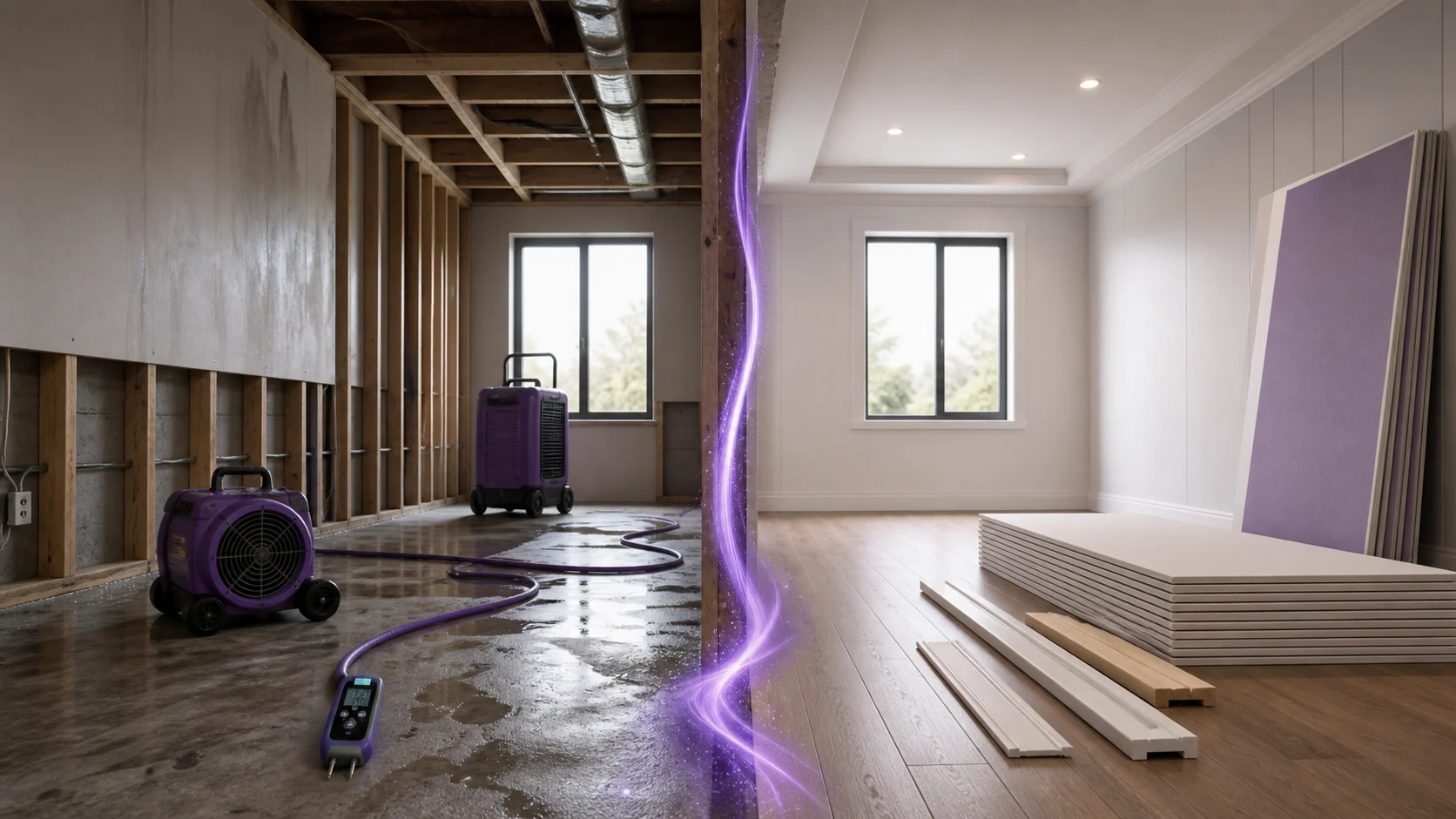
When water affects a building, the desired outcome is easy to understand: make the space usable again. The work needed to reach that outcome, however, is often divided into separate stages.
Water mitigation and rebuilding are related, but they do not solve the same problem. Mitigation focuses on limiting additional water-related impact, evaluating affected materials, removing accessible water when appropriate, and moving the area through controlled drying and moisture monitoring. Rebuild is the later construction stage that repairs or replaces materials and finishes.
Understanding the difference helps property owners ask clearer questions, recognize what has been completed, and avoid treating a partially completed stage as the end of the entire project.
What water mitigation is intended to accomplish
For this discussion, water mitigation means work directed at the active moisture condition and the materials it affected. The exact plan depends on the source, type and extent of the water, the materials involved, access, and site conditions.
A mitigation plan may include:
- documenting the areas where water was reported or observed;
- confirming that the active source is controlled or identifying when another appropriate trade is needed;
- removing standing or accessible water when conditions allow;
- evaluating affected and adjoining materials;
- determining whether materials can remain, need access for drying, or require another decision;
- establishing controlled drying conditions;
- tracking moisture at repeatable locations; and
- documenting changes, limitations, and the basis for completing the drying stage.
Not every water event requires every action on this list. Mitigation should follow the actual conditions rather than a fixed script.
The central question is: What is needed to control the water-related condition and establish evidence about the affected materials?
Drying is part of mitigation, not the rebuild itself
Removing visible water does not necessarily complete mitigation. Water can remain in porous materials, seams, cavities, or layers beneath a finish. Structural drying addresses moisture held in materials intended to remain, while moisture monitoring helps show whether those materials are changing over time.
The U.S. Environmental Protection Agency advises against sealing previously wet cavities or applying paint and sealants until materials are dry internally. FEMA technical guidance likewise warns that rebuilding before adequate drying can trap moisture within the building.
Those sources address flood recovery, which can involve hazards and conditions beyond a smaller indoor leak. The sequencing principle is still useful: replacement finishes should not be used to hide an unresolved moisture condition.
A room may therefore be ready to leave the active drying stage without yet looking fully restored. Missing trim, an opened access area, or an unfinished wall surface can mark the boundary between completed mitigation and work that belongs to rebuild.
What the rebuild stage does
Rebuild, also called reconstruction or repair, addresses materials and finishes that need to be restored after mitigation decisions are complete.
Depending on the property and scope, rebuild work can include:
- replacing removed wallboard or insulation;
- repairing wall or ceiling surfaces;
- replacing trim, baseboards, or doors;
- installing flooring or underlayment;
- repairing cabinetry or other built-in finishes;
- taping, finishing, priming, or painting; and
- restoring the room’s final appearance and function.
These examples explain the stage; they do not mean that every affected property needs all of them.
Rebuild also involves different construction questions. The repair professional may need to determine the correct assembly, materials, dimensions, finish match, applicable requirements, permits, and sequencing with other trades. Those decisions are separate from measuring drying progress.
The central rebuild question is: What construction work is needed to restore the components and finishes after the moisture condition has been addressed?
Selective removal does not make mitigation the same as rebuilding
The distinction can seem unclear when limited material removal is needed during mitigation. A baseboard may need to be detached to expose a wall edge. A non-salvageable material may need to be removed. Access may be required so an otherwise enclosed area can be evaluated or dried.
Those actions support the moisture-control objective. They do not, by themselves, complete the later construction work.
A simple way to distinguish the stages is to ask why an action is occurring:
- If the purpose is to reach, evaluate, remove, or dry water-affected material, it may belong to mitigation.
- If the purpose is to replace, finish, and return the component to its final constructed appearance, it generally belongs to rebuild.
The actual scope should be stated in writing because the same material may appear in both stages for different reasons.
The handoff should be based on evidence
Mitigation does not need to make a room cosmetically complete, but it should leave the next party with a clear record of what was done and what remains.
Depending on the project, useful handoff information can include:
- the areas and materials evaluated;
- the locations used for moisture monitoring;
- relevant trends or comparison points;
- materials removed or left in place;
- conditions or locations that could not be assessed;
- changes made during the drying process;
- the basis used to end monitored drying; and
- items explicitly excluded from the mitigation scope.
This record does not design the rebuild or guarantee the condition of inaccessible components. It gives the property owner and later repair professional a clearer starting point. Photographs can support the record when tied to dates and locations. A meter image without the material and location identified provides less useful context than a labeled drying log.
Why the order matters
Beginning finish work before the moisture condition is adequately evaluated can create avoidable uncertainty. A new floor may cover a layer that still needed review. Paint may make a wall appear complete without answering what is happening inside the assembly. Closing an access opening can make later evaluation more difficult.
That does not mean every project requires a long delay or invasive investigation. It means the transition should follow evidence appropriate to the materials and conditions, not appearance alone or a predetermined number of days.
Drying time varies. Material type, water path, access, temperature, humidity, assembly design, and whether the source remains controlled can all affect the process. Neither the mitigation provider nor the rebuild contractor should promise a universal timeline without evaluating the actual situation.
Planning may overlap even when the work does not
Property owners do not always need to wait until the last drying reading to begin discussing the later repair scope. Measurements, material selections, estimates, or scheduling may be considered while mitigation is underway.
Planning ahead is different from installing finishes before the area is ready. The decision to begin physical reconstruction should account for the drying record, the condition of the materials, remaining access needs, and any separate requirements identified by the repair professional.
Clear role boundaries also matter. The mitigation provider should explain what its work includes. The repair professional should explain the construction scope. If another trade is needed for plumbing, electrical, HVAC, structural, environmental, or other specialized work, that responsibility should be identified rather than assumed.
Questions property owners can ask
- Are we controlling and drying the water-affected area, or repairing finishes?
- Has the active water source been addressed by the appropriate party?
- Which materials are being monitored, removed, or left in place?
- What evidence will support completion of monitored drying?
- Are any areas inaccessible or outside the mitigation scope?
- Which materials or finishes will still require repair?
- Who is responsible for the rebuild scope?
- Will the rebuild professional receive the relevant mitigation documentation?
Clear answers reduce the risk of assuming that one provider, contract, or completion date covers both stages.
X Restorations’ current scope
X Restorations currently focuses on water mitigation, structural drying, and moisture monitoring. Reconstruction and finish repair are outside the company’s present service scope.
That boundary does not make the stages unrelated. It makes the handoff important. Mitigation should address and document the moisture condition within its approved scope; the property owner can then arrange any needed reconstruction separately with the appropriate repair professional.
If indoor water has affected accessible building materials, contact X Restorations to discuss what you observed and confirm whether the requested mitigation work is available. The appropriate plan depends on the source, materials, access, and actual site conditions.
Educational information only. Conditions, hazards, access, and appropriate work vary by property and water event.