
Resources
Why Low Indoor Humidity Does Not Prove Building Materials Are Dry
Learn why low room humidity does not prove porous building materials are dry, and how ambient and material trends support better decisions.
Educational information: This article is not a property assessment, engineering or environmental opinion, dispatch promise, insurance determination, or authorization for work.
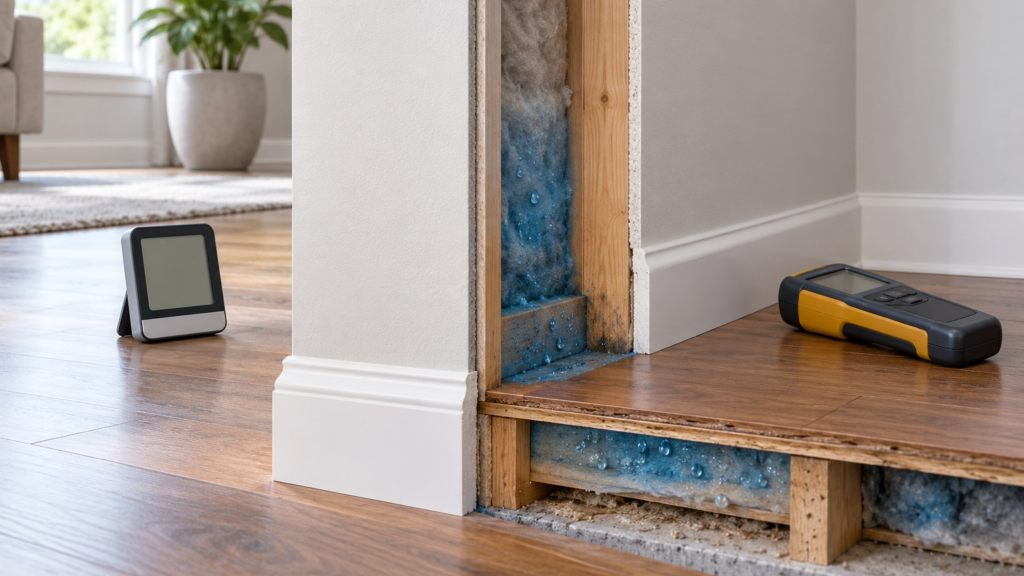
A room can feel comfortable and a humidity monitor can show that the air is becoming drier while wood, gypsum, concrete, insulation, or another porous material still contains moisture. Those observations are related, but they do not measure the same thing. Indoor relative humidity describes the air at a particular temperature. Material readings and observations describe conditions in the building assembly.
That distinction matters after an indoor water intrusion. A lower room-humidity reading may show that the drying environment is changing, but it does not by itself establish which materials were affected, whether moisture remains below a surface, or whether an assembly is ready to be enclosed or repaired. A defensible conclusion combines ambient conditions with material-specific observations, repeatable locations, and documented trends.
Relative humidity describes air, not the moisture content of a wall or floor
Relative humidity is the amount of water vapor in the air compared with the maximum the air could hold at its current temperature. The U.S. EPA’s Moisture Control Guidance for Building Design, Construction and Maintenance explains that relative humidity changes when air temperature changes even if the absolute amount of water vapor stays the same. That is why one relative-humidity number should not be treated as a direct reading of a board, wall cavity, adhesive layer, or concrete surface.
Air temperature, relative humidity, humidity ratio, vapor pressure, and dew point help describe the drying environment and condensation risk. They are valuable, but they do not replace information about the materials themselves. A room can have dry air while moisture remains bound within a porous material or restricted behind a low-permeance finish.
A lower relative-humidity reading can have more than one explanation
Relative humidity can fall because water vapor was removed from the air. It can also fall because the air warmed. Those are not equivalent changes. Dehumidification can reduce the vapor load, while heating without vapor removal may change the displayed relative humidity without removing the same amount of water from the space.
The EPA guidance uses dew point to explain the amount of water vapor in air more directly and to evaluate whether vapor may condense on a cooler surface. Even then, dew point remains an air property. It helps show what the surrounding air can do, not how much moisture is stored in every material or whether a concealed layer is accessible to that air.
Materials release moisture at different rates
Evaporation requires moisture to move from a material toward its surface and then into the surrounding air. The rate is influenced by the material, temperature, air conditions, exposed surface area, and air movement. The EPA notes that water can be held more tightly in porous materials and that moving ventilating air through many of those materials is difficult. Paint, vinyl wall covering, flooring, cabinets, insulation, and other layers can also limit the path available for drying.
This means the room air may respond before the assembly does. A dehumidifier can make the air capable of accepting more vapor, but moisture still must migrate from the affected material to the air. A concealed surface, dense product, multilayer assembly, or area with limited access may respond differently from an exposed gypsum panel or wood surface.
One room reading cannot represent every microclimate
Ambient conditions can vary across the same property. Air near the outlet of a dehumidifier may differ from air behind a closed cabinet, beneath flooring, inside a wall cavity, or near an exterior surface. Temperature differences can also change local relative humidity and condensation risk. A monitor placed in a convenient open area does not automatically describe a confined or concealed space.
Useful documentation identifies where an ambient reading was taken, the date and time, the instrument, and the surrounding conditions. It also distinguishes room-air observations from material readings. The goal is traceability: another reviewer should be able to understand what was measured, where it was measured, and what changed later.
Material readings need their own context
Moisture instruments do not all work the same way. Some use pins while others scan without penetrating the surface. Many evaluation methods infer a material condition indirectly rather than measure it directly, so the method must fit the material and its calibration, operating principles, and limitations must be understood. The U.S. National Institute of Standards and Technology’s review of nondestructive evaluation methods for installed building materials explains why indirect measurements require an appropriate relationship to the property of interest and careful interpretation. A reading should be associated with the specific material, instrument, setting, location, and method used. Numbers from unlike materials or different devices should not be treated as interchangeable.
Affected readings are often more useful when compared with appropriate, accessible material believed to be unaffected and when repeated at the same mapped locations. The purpose is not to create a universal “dry” number. It is to understand the pattern, direction of change, and limits of the available evidence. Our guide to moisture mapping after water intrusion explains how locations and materials can be connected to a traceable record.
Trends are stronger than an isolated snapshot
A single low room-humidity reading is a snapshot. Repeated ambient and material observations can show whether conditions are changing together. For example, the air may stabilize while a material continues to release moisture, or the material trend may plateau while the room remains dry. Either pattern can prompt a closer review of access, airflow, dehumidification, material condition, or the original moisture map.
Documentation should not imply precision that the instrument or access does not support. It should record relevant limitations, including areas that could not be reached, finishes that may affect readings, and changes in temperature or equipment placement. Consistent methods make the trend more meaningful; changing instruments or locations without noting the change can make comparisons misleading.
Dry air is not permission to close an assembly
The EPA guidance advises testing the moisture content of porous materials before closing cavities or applying adhesives and finishes. That principle is important because enclosing a damp layer can restrict its remaining drying path. Readiness for repair depends on the material, the assembly, manufacturer requirements, site conditions, and the evidence collected—not on room relative humidity alone.
The same caution applies to surfaces that look normal. Our article Why a Floor Can Look Dry While Moisture Remains Below describes how a visible finish, adhesive, underlayment, and substrate can show different conditions. A clean appearance or comfortable room does not resolve what remains concealed.
Air movement and dehumidification have different roles
Air movement can support evaporation at an exposed wet surface. Dehumidification removes water vapor from the air and helps preserve the air’s capacity to receive more moisture. Heat changes air and material conditions and can affect evaporation. These functions interact, but one does not substitute automatically for another, and equipment use must fit the water source, materials, access, and safety conditions.
Air movement should not be treated as universally appropriate. Suspected sewage, chemical contamination, microbial contamination, electrical hazards, unstable materials, or unsafe access require different controls and qualified evaluation. The EPA’s clean-water cleanup table specifically warns against using fans before determining that the water is clean or sanitary. Equipment should never be energized in an unsafe environment.
What a useful drying record should separate
- Source and safety: what is known, what remains uncertain, and what hazards or access limits exist.
- Ambient conditions: air temperature, relative humidity, and other psychrometric values used, with location and time.
- Material conditions: the specific material, measurement point, instrument, setting, method, and comparison basis.
- Equipment and layout: relevant placement or operating changes that may affect later comparisons.
- Trend: whether repeat observations are decreasing, stable, increasing, or inconsistent.
- Limitations: concealed layers, inaccessible areas, coatings, assemblies, or other factors that reduce certainty.
The public overview of the ANSI/IICRC S500 Standard for Professional Water Damage Restoration identifies psychrometry and drying technology, equipment and instruments, project documentation, inspections, safety, and materials and assemblies as connected subjects. The overview does not provide a site-specific formula or one numerical endpoint for every project. It reinforces why air data, material data, documentation, and professional judgment belong in the same process.
Questions to ask before calling a material dry
- Does the conclusion refer to the room air, one surface, or the complete affected assembly?
- Were the same materials and mapped locations checked more than once?
- Were ambient and material readings clearly separated in the record?
- Are affected readings compared with suitable material believed to be unaffected?
- Could temperature, a coating, an adhesive, a concealed layer, or limited access affect interpretation?
- What evidence supports repair, enclosure, continued drying, additional access, or a change in approach?
These questions complement our practical list of questions to ask before water mitigation begins. Clear answers do not guarantee an outcome, but they make the scope and the basis for decisions easier to review.
When to request a professional assessment
If indoor water may have reached porous or concealed materials, a documented assessment can help distinguish the drying environment from the condition of the assembly. X Restorations focuses on water mitigation, structural drying, and moisture monitoring. Learn about its water damage restoration service or contact X Restorations to describe the source, affected areas, available access, and immediate safety concerns. Scope and service availability depend on site-specific conditions.
Official sources and scope
- U.S. EPA: Moisture Control Guidance for Building Design, Construction and Maintenance
- U.S. EPA: full-text version of the moisture-control guidance
- U.S. EPA: Water Damage—Cleanup and Mold Prevention, Table 1
- NIST: Nondestructive Evaluation Methods for Quality Acceptance of Installed Building Materials
- IICRC: ANSI/IICRC S500 public overview
The EPA moisture-control document addresses buildings broadly; its clean-water table is limited to clean-water damage and does not apply unchanged to contamination. The NIST paper reviews general principles and limitations of nondestructive evaluation; it is not a restoration-specific drying standard. The IICRC page is a public overview of the standard’s subject areas, not the complete standard. This article is educational, does not establish a universal drying target, and does not determine the condition or scope of a specific property.