
Resources
Why a Floor Can Look Dry While Moisture Remains Below
A floor finish can appear dry while underlayment, adhesive, or substrate conditions differ. Learn why layered assemblies need material-specific observations.
Educational information: This article is not a property assessment, engineering or environmental opinion, dispatch promise, insurance determination, or authorization for work.
A floor can appear normal soon after visible water is removed. The surface may no longer shine, feel wet, or show an obvious stain. That does not establish that every layer below has reached the same condition. Flooring is usually an assembly: the visible finish may sit over adhesive, padding, underlayment, a wood subfloor, or a concrete substrate. Each layer receives, stores, and releases moisture differently.
This distinction matters because a dry-looking finish can conceal conditions that influence cleaning, drying, removal, and later repair decisions. A responsible assessment treats appearance as one observation, then considers the water source, the materials involved, how the layers are connected, where moisture may have traveled, and whether changes can be documented over time.
A floor is an assembly, not one uniform material
What people call “the floor” may include several products with very different properties. A resilient plank can limit evaporation from the surface while an absorbent underlayment remains below it. Tile may look unchanged while moisture is present in grout, setting material, or the supporting layer. Carpet fibers may begin to feel dry before the backing, cushion, or subfloor does. Wood flooring, engineered products, adhesives, and concrete introduce still other variables.
The U.S. EPA’s clean-water response table specifically tells readers to check whether the underflooring beneath carpet or other flooring is dry. It also separates recommendations by material rather than treating a whole room as one surface. That material-by-material approach is more useful than relying on color, temperature, touch, or a single reading taken only from the finish.
Why the layers can show different conditions
Liquid water can enter at seams, edges, penetrations, transitions, or damaged areas and then move laterally beneath a finish. Some materials absorb moisture into their structure; others slow its movement. A relatively vapor-resistant finish may reduce drying toward the occupied side even after the top has been wiped or extracted. Moisture can also remain at an interface where two materials meet, such as adhesive between a finish and a substrate.
Conditions below a floor are not necessarily uniform. One section may be exposed to air movement while another is confined by cabinetry, baseboards, transitions, or a tightly bonded finish. A slab, underlayment, and wood-based subfloor also respond differently to the same environment. For that reason, one dry-looking spot cannot represent the entire assembly.
Different floor systems create different questions
- Carpet and cushion: The face fibers, backing, cushion, and subfloor are separate layers. Surface improvement does not establish that the cushion or supporting material is clean, accessible, or dry.
- Resilient flooring: Vinyl, linoleum, and similar finishes may conceal conditions at seams, adhesive, underlayment, or substrate. Changes such as lifting or loss of bond can be relevant, but their absence is not proof that lower layers are unaffected.
- Wood and engineered products: Species, construction, finish, installation method, and supporting layers affect how observations and readings should be interpreted. Gaps, cupping, swelling, or delamination may matter, but a flat surface alone is not a moisture conclusion.
- Tile over mortar, backer, wood, or concrete: The visible tile may change little while adjacent materials behave differently. Grout lines and isolated surface readings do not describe every layer below.
Concrete deserves particular context. It is porous, and readings obtained at or near its surface may be influenced by the instrument, depth, ambient conditions, salts, temperature, and the floor covering. No one number from an unrelated material or device should be transferred automatically to a concrete assembly.
Appearance and instruments both have limits
Touch and sight are useful for documenting visible conditions, but they are not reliable substitutes for material-specific assessment. In its flood-recovery guidance, FEMA explains that moisture can be difficult to assess accurately by touch or sight alone and calls for checking wetted, salvageable materials with an appropriate moisture meter and rechecking them before rebuilding. That guidance addresses flooded buildings; it should not be converted into one universal numerical rule for every floor, material, instrument, or water event.
Moisture instruments also require context. Different devices respond to different physical properties and depths, and some provide comparative indications rather than a direct measurement of every hidden layer. Surface scanning can help identify patterns, while other conditions may require a different instrument, access point, or evaluation method. Readings should be tied to the material, location, device, settings, date, and surrounding conditions.
The water source changes the safety decision
The EPA material table applies to clean-water damage. It expressly warns that suspected sewage, chemical pollutants, or biological contamination requires different controls and experienced professional input. It also says not to use fans before determining that the water is clean or sanitary. Air movement can spread contaminants when the source or affected environment is unsafe.
Floodwater, sewage, chemicals, electrical hazards, weakened materials, and unsafe access should not be approached as ordinary drying questions. Conditions may call for isolation, personal protective equipment, specialized cleaning, removal, or evaluation by qualified trades. Dry appearance does not resolve those hazards, and drying equipment should not be energized in an unsafe environment.
Material-specific monitoring supports better decisions
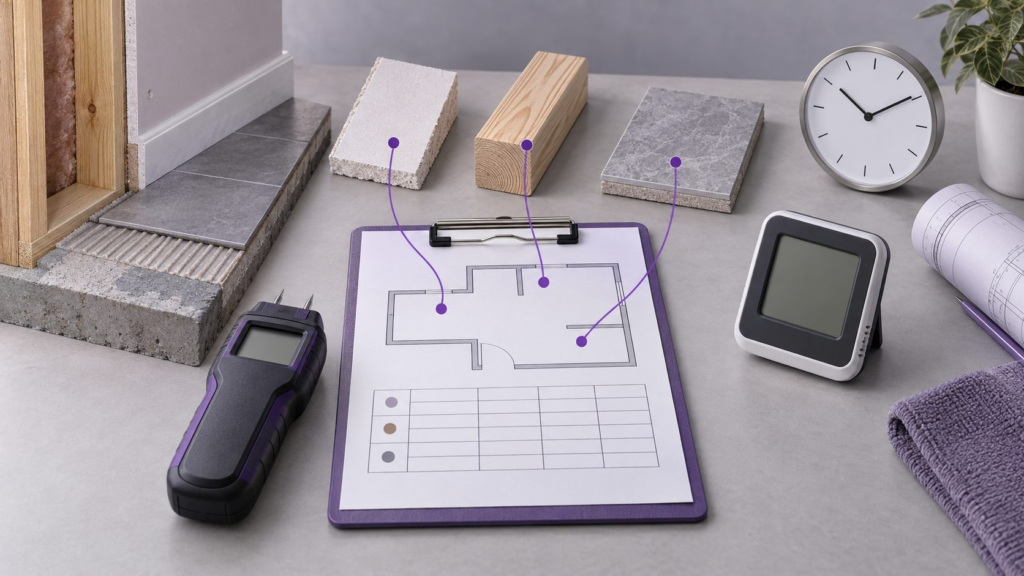
A useful moisture map connects observations and readings to defined locations and materials. It may include the visible finish, accessible edges, transitions, nearby walls, comparable unaffected materials, and supporting layers when they can be evaluated appropriately. The purpose is not to produce a colorful diagram; it is to make the evidence traceable and identify where the assembly behaves differently.
Repeated observations are generally more informative than an isolated number. A record can show whether an area is changing, remaining stable, or diverging from comparable material. Interpretation still depends on the product, instrument, installation, environmental conditions, manufacturer information, and professional judgment. There is no universal moisture threshold that determines preservation, removal, or readiness for every floor.
Dry in place or remove is an assembly-level decision
The question is not simply whether the visible finish can lose moisture. A decision may consider the apparent cleanliness of the water, the condition and cleanability of each layer, access to concealed areas, adhesive performance, dimensional change, integrity, and whether progress can be verified. The article Dry in Place or Remove? What Shapes the Decision After Water Intrusion explains why preservation and removal should both be tied to documented site conditions rather than an automatic rule.
Attempting to preserve an assembly without access or verification can leave uncertainty below the finish. Removing material without considering its condition and the available evidence can also expand the scope unnecessarily. The appropriate choice may change if additional layers are exposed, contamination is identified, or monitoring shows that the assembly is not responding as expected.
What a documented floor assessment should clarify
- What is known—and not known—about the source and apparent cleanliness of the water?
- Which finish, adhesive, cushion, underlayment, subfloor, or substrate may be involved?
- Where were observations and readings taken, and which areas remain inaccessible?
- What instrument and method were used for each material?
- How will changing conditions be compared and documented?
- What findings would support continuing, changing, or ending the current approach?
Documentation does not guarantee a result. It creates a clearer basis for communication and helps prevent a surface-only impression from becoming the entire decision.
How structural drying fits into the process
Structural drying after indoor water intrusion involves more than operating equipment. It connects source control, safety, the affected materials, environmental conditions, access, and follow-up observations. Air movement and dehumidification perform different functions, and their placement or use must fit the assembly and the hazards present. No fixed drying time applies to every floor.
The public overview of ANSI/IICRC S500 identifies building and material science, psychrometry and drying technology, equipment and instruments, project documentation, inspections, safety, and materials and assemblies among the subjects covered by the professional standard. The overview does not provide a project-specific formula or authorize conclusions about a particular floor without an on-site assessment.
When to request a professional assessment
If indoor water may have reached more than the visible finish, an assessment can help distinguish the layers involved and the limits of what can be verified without additional access. X Restorations focuses on water mitigation, structural drying, and moisture monitoring. Learn about its water damage restoration service or contact X Restorations to describe what is known about the source, the affected areas, and any immediate safety concerns. Scope and service availability depend on site-specific conditions.
Official sources and scope
- U.S. EPA: Moisture Control Guidance for Building Design, Construction and Maintenance
- U.S. EPA: Water Damage—Cleanup and Mold Prevention, Table 1
- IICRC: ANSI/IICRC S500 Standard for Professional Water Damage Restoration—public overview
- FEMA: Cleaning Flooded Buildings
The EPA guidance addresses moisture control broadly; its Table 1 is specifically framed around clean-water damage. The IICRC page is a public overview of the standard’s subject areas, not the complete standard. The FEMA fact sheet addresses recovery after flooding, so its observations about meters and rechecking materials provide useful context but not a universal threshold for unrelated assemblies. This article is educational and does not determine the condition or scope of a specific property.