
Resources
Dry in Place or Remove? What Shapes the Decision After Water Intrusion
Learn why material type, water source, condition, access, and moisture verification shape the decision to dry in place or remove.
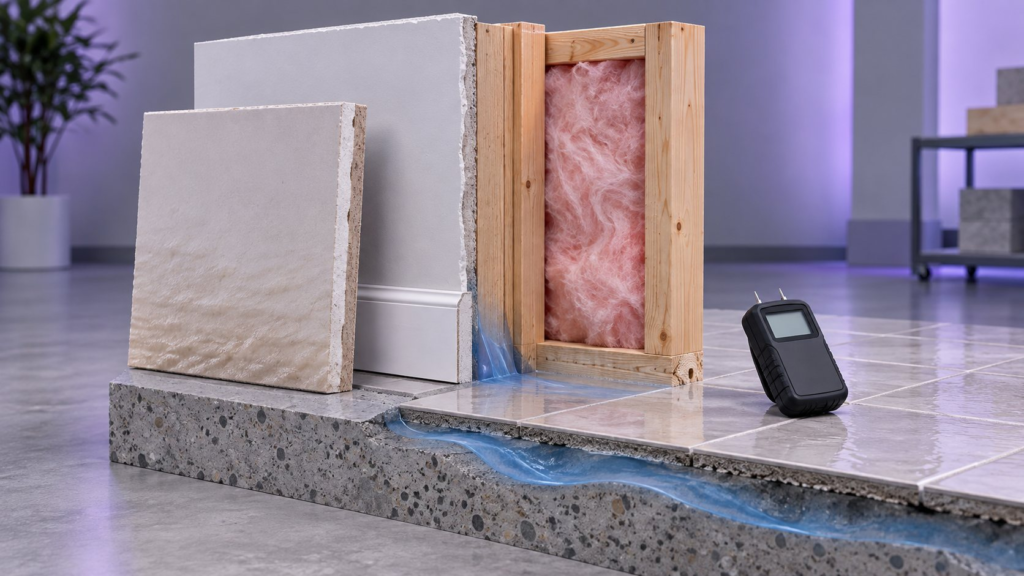
Educational information: This article is not a property assessment, engineering or environmental opinion, dispatch promise, insurance determination, or authorization for work.
After an indoor water intrusion, one of the most important questions is whether an affected material can remain in place while it is dried or whether removal should be considered. The answer is not based on appearance alone. Material type, water source, physical condition, access, and the ability to verify moisture conditions all shape the decision.
Federal guidance from the U.S. Environmental Protection Agency and the Centers for Disease Control and Prevention supports a material-specific approach. Some assemblies may be candidates for drying under appropriate conditions, while others can retain moisture, lose integrity, or require removal because of contamination or damage.
A qualified on-site assessment is needed before choosing a course of action. The following factors explain why two rooms—or even two sections of the same wall—may require different responses.
There Is No Universal Dry-or-Remove Rule
Water does not affect every building material in the same way. Dense, nonporous surfaces generally behave differently from paper-faced gypsum, insulation, engineered wood, or layered flooring. The EPA’s material guidance distinguishes among these surfaces rather than applying one rule to an entire room. That is why a water damage restoration assessment should consider each affected component separately and in context.
Elapsed time matters, but it is only one part of the evaluation. A decision should not rely on a universal hour threshold or a promise that a material will always be saved if work begins by a particular time.
The Material and Its Condition Shape the Options
The material’s composition, finish, and current condition can change what is reasonably possible. EPA guidance notes, for example, that gypsum wallboard may sometimes be dried in place when it has not swollen and its seams remain intact. Visible swelling, separation, crumbling, loss of adhesion, or other deterioration can point toward a different scope.
That example is conditional, not a blanket rule for every wall. Paint, wall coverings, insulation, fasteners, framing, and the cavity behind the surface can all affect how moisture moves and whether drying progress can be evaluated. Flooring systems also need to be considered as assemblies: the finish may look dry while an underlayment, adhesive, or substrate remains affected.
The Water Source Changes the Safety Context
The source and apparent cleanliness of the water are essential considerations. EPA’s material table is framed around clean-water damage and specifically cautions that contaminated water calls for different evaluation and controls. Suspected sewage, chemical contamination, or other hazardous conditions should not be treated as an ordinary drying question.
Occupants should avoid disturbing questionable materials or entering areas with structural, electrical, or contamination hazards. Appropriate qualified parties can evaluate those risks and determine the controls, protective equipment, containment, and removal methods the situation may require.
Access and Hidden Assemblies Matter
A surface can appear normal while moisture remains behind it. Wall cavities, insulation, baseboard transitions, cabinet toe kicks, floor layers, and other concealed areas may be difficult to assess from the finished side. EPA guidance recognizes that enclosed wall cavities can be challenging to dry, which makes access and verification part of the decision—not an afterthought.
Moisture mapping helps define the affected area by organizing readings and observations across rooms and materials. It does not diagnose every concealed condition, but it can help identify where further investigation may be warranted and keep the scope tied to documented evidence.
“Dry in Place” Still Requires Active Verification
Drying in place does not mean leaving a material untouched and assuming it will recover. It describes a managed approach in which the material remains while conditions and progress are evaluated. The drying setup, environmental conditions, access to the assembly, and changes in measured moisture all matter.
Consistent moisture monitoring during water mitigation can show whether conditions are moving in the expected direction. Readings are most useful when they are interpreted alongside material type, comparison areas, visual observations, and the limitations of the measurement method. No single reading should be presented as a guarantee about an entire assembly.
When Removal May Become Part of the Scope
Removal may be considered when a material has lost integrity, cannot be accessed or effectively evaluated in place, remains affected despite the drying approach, or is incompatible with the contamination conditions. It can also be necessary when retaining one layer prevents assessment or treatment of another affected layer behind or beneath it.
Removal should be connected to documented conditions rather than used as an automatic response to every water event. Likewise, preservation should not be promised simply because a surface still looks acceptable. Structural drying after indoor water intrusion is a process of evaluating assemblies and adapting the scope as evidence develops.
What a Documented Decision Should Explain
A clear record should identify the affected material, the observed condition, the known or suspected water source, the accessible and concealed areas considered, and the evidence supporting the proposed approach. When drying in place is selected, the record should also explain how progress will be monitored and what findings could prompt reassessment.
Useful questions for a property owner include:
- Which materials and layers were evaluated?
- What conditions support drying in place or removal?
- How will moisture conditions and progress be documented?
- Are there inaccessible areas or safety concerns requiring another qualified party?
- What finding would cause the scope to change?
A Site-Specific Path Forward
A sound decision balances preservation with safety, material condition, and verifiable drying progress. It cannot be made reliably from a photograph, a universal timeline, or the visible surface alone. If your property has experienced an indoor water intrusion, contact X Restorations to discuss an on-site assessment and the documented conditions that may shape the mitigation scope.