
Resources
Water Extraction and Structural Drying Are Different Steps
Learn how removing accessible water differs from drying moisture retained in building materials, and why source control, safety and monitoring matter.
Educational information: This article is not a property assessment, engineering or environmental opinion, dispatch promise, insurance determination, or authorization for work.
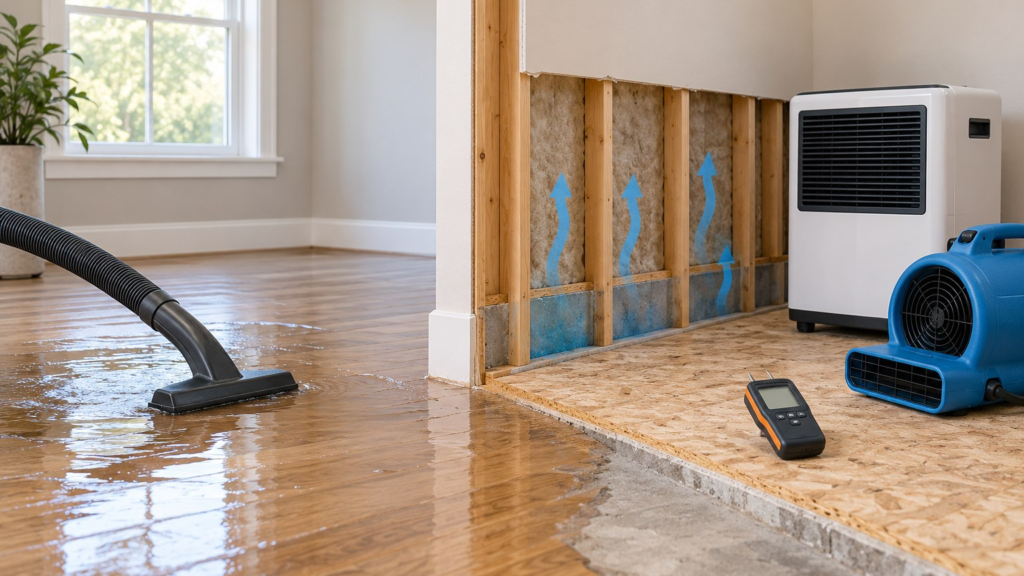
Removing visible water and drying a building assembly are connected tasks, but they are not the same task. Extraction targets accessible liquid water. Structural drying addresses moisture that remains in wood, gypsum, concrete, subflooring, insulation, adhesives, cavities, and other materials after the obvious water is gone.
That distinction matters after an indoor water intrusion. A floor can look clear after extraction while porous or concealed layers still need evaluation. At the same time, operating drying equipment cannot compensate for an active leak, an unresolved drainage path, unsafe electricity, or water whose contamination has not been assessed. A useful plan separates the source, safety, liquid-water removal, material condition, drying environment, and verification.
Extraction removes accessible liquid water
Extraction is the removal of standing or readily recoverable water from areas that can be reached safely. Depending on the setting, this may involve pumps, extraction equipment, or other controlled removal methods. Its purpose is to reduce the volume of liquid water available to spread, soak into materials, or continue loading the indoor environment with moisture.
The U.S. EPA’s Water Damage—Cleanup and Mold Prevention table lists water extraction separately from reducing ambient humidity and accelerating drying. The table is specifically written for clean-water damage and warns that a different approach is required when the source may be contaminated. It should not be treated as a universal do-it-yourself procedure.
Structural drying addresses moisture retained in materials
After accessible liquid water is removed, moisture can remain within porous materials, between layers, below finishes, or in cavities. Structural drying is the managed process of helping that retained moisture move toward exposed surfaces and into the air, then controlling the water vapor in the air. Material type, thickness, coatings, temperature, airflow, vapor pressure, and access can all influence that process.
Drying is therefore more than placing a fan in a room. The U.S. EPA’s Moisture Control Guidance for Building Design, Construction and Maintenance explains how liquid water, airflow, vapor diffusion, condensation, and material properties interact. For a drying plan, equipment selection and placement therefore depend on the source, affected materials, assembly, access, and safety conditions. For the broader sequence from moisture mapping and extraction through monitored drying and verification, see our overview of structural drying after indoor water intrusion.
Source control and safety come before an equipment plan
If water is still entering, the affected area can be rewetted while drying is underway. Source control may involve stopping a plumbing release, correcting drainage, arranging a qualified roof intervention, or limiting another entry path. The EPA identifies control of liquid water as the first moisture-control principle. A temporary measure can reduce further entry in some situations, but it does not become a permanent repair or prove that interior materials are dry.
Safety conditions also shape the sequence. The CDC advises against operating electrical tools or appliances while standing in water and says electrical equipment that has been wet should be inspected by a qualified electrician before power is restored. The EPA’s clean-water table says not to use fans before determining that the water is clean or sanitary. Suspected sewage, chemicals, microbial contamination, unstable materials, or unsafe access require controls beyond ordinary drying equipment.
The two steps can overlap without becoming interchangeable
Real projects do not always divide into a simple “extraction day” followed by a separate “drying day.” Controlled extraction may continue in one area while accessible, appropriate materials begin drying elsewhere. Drainage from an assembly may reveal additional liquid water, and removing a finish can change the available drying path. The important point is that each action has a defined purpose and evidence behind it.
An extraction result does not by itself establish a drying endpoint. Conversely, lower room humidity does not prove that every material has released retained moisture. Our article Why Low Indoor Humidity Does Not Prove Building Materials Are Dry explains why air conditions and material conditions must be documented separately.
Materials and assemblies change what can be dried
A finished floor may include a surface layer, adhesive, underlayment, subfloor, and structural substrate. A wall may include paint, paper-faced gypsum, insulation, wood or metal framing, sheathing, and an exterior layer. Water can move along seams, fasteners, gaps, and porous materials, so the visible surface does not necessarily represent the complete assembly.
Some materials may be candidates for controlled drying when they remain sound and can be accessed appropriately. Others may need removal because they are damaged, contaminated, swollen, delaminated, inaccessible, or unable to be cleaned and dried reliably. The decision is material- and site-specific. See Dry in Place or Remove? What Shapes the Decision After Water Intrusion for the factors that should be separated from a one-size-fits-all answer.
Moisture monitoring connects extraction to structural drying
A moisture map can connect each observation to a material and location, helping distinguish the visible water footprint from the documented affected area. Repeated observations can then show whether conditions are changing, stable, inconsistent, or expanding. The CDC notes that moisture meters can provide qualitative information across several building materials and can help monitor progress in drying wet materials.
Readings need context: the material, instrument, setting, location, date and time, comparison basis, and any change in access or equipment. A reading from wood should not be treated as interchangeable with a reading from gypsum or concrete. Our guide to moisture mapping after water intrusion explains how those locations support a traceable record.
What a useful project record should separate
- Source status: what released or admitted water, whether entry is active, and what temporary or permanent control has been verified.
- Safety and water conditions: known electrical, structural, contamination, occupancy, or access limitations.
- Extraction: where accessible liquid water was found and what areas were reached.
- Materials and assemblies: what layers are present, which appear affected, and which remain concealed or inaccessible.
- Drying environment: relevant ambient conditions and equipment changes, recorded by location and time.
- Material monitoring: mapped points, methods, repeat observations, comparison areas, and documented limitations.
- Decision basis: evidence supporting continued drying, additional access, removal, repair, or reevaluation.
FEMA’s Cleaning Flooded Buildings guidance separates water removal, material evaluation, drying equipment, and rechecking materials before rebuilding. Its specific thresholds and procedures apply to the post-flood context described in that document; they are not universal endpoints for every material or every indoor water event.
What occupants can document safely
Without entering unsafe areas or disturbing assemblies, an occupant can record when water was first noticed, the apparent source, rooms or surfaces where changes are visible, and whether conditions appear to be changing. Photos taken from a safe location can preserve context. Do not open wet electrical equipment, energize devices near water, enter unstable areas, or remove materials when contamination or other hazards may be present.
Useful questions include whether the source has been controlled, what areas were evaluated, how hidden layers were considered, how extraction and drying are being distinguished, and what evidence will support the next decision. Our questions to ask before water mitigation begins provide a practical starting point.
When to request a documented assessment
A documented assessment is appropriate when water may have reached porous or concealed materials, the source or water condition is uncertain, the area appears to be rewetting, or electrical, structural, or contamination concerns limit safe access. X Restorations focuses on water mitigation, structural drying, and moisture monitoring. Learn about its water damage restoration service or contact X Restorations to describe the source, observed areas, available access, and immediate safety concerns. Scope and service availability depend on site-specific conditions.
Official sources and scope
- U.S. EPA: Moisture Control Guidance for Building Design, Construction and Maintenance
- U.S. EPA: Water Damage—Cleanup and Mold Prevention, Table 1
- FEMA: Cleaning Flooded Buildings
- CDC: Mold Prevention Strategies and Possible Health Effects After Hurricanes and Major Floods
- CDC: What to Do to Protect Yourself From Electrical Hazards
- IICRC: ANSI/IICRC S500 public overview
The EPA cleanup table is limited to clean-water damage. The FEMA and CDC documents include flood and disaster contexts that do not transfer unchanged to every indoor loss. The IICRC page is a public overview of subject areas, not the complete standard. This article is educational; it does not determine a property’s condition, prescribe equipment, establish a universal drying target or timeline, promise an outcome, or address insurance coverage.